What Is Ovarian Reserve?
Ovarian reserve refers to the remaining supply of eggs, also called oocytes, in a woman's ovaries. It is one of the factors healthcare professionals consider when assessing reproductive health and planning fertility treatment.
The number of eggs is highest before birth and naturally decreases over time. This happens through biological processes that include follicular atresia, or the degeneration of follicles, as well as the process associated with ovulation.
Ovarian reserve is not the same as egg quality. The number of eggs remaining does not tell us by itself whether an egg can be fertilised or develop into a healthy pregnancy. Age is also an important factor in reproductive outcomes.
Low ovarian reserve does not automatically mean natural pregnancy is impossible. Test results should be interpreted alongside age, medical history and other fertility factors.
How Is Ovarian Reserve Tested?
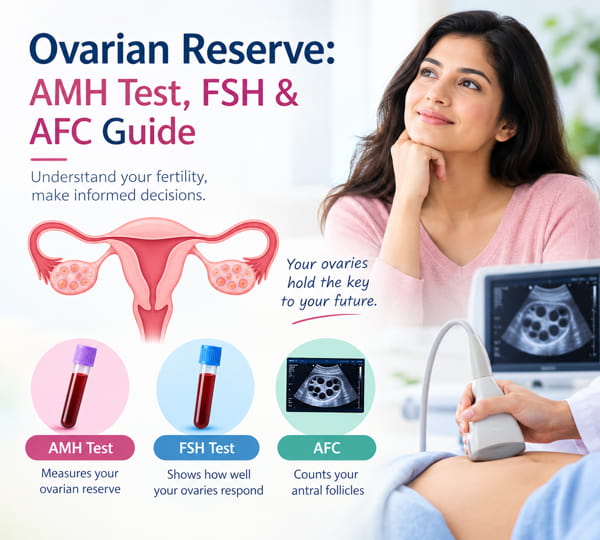
Fertility specialists commonly use blood tests and ultrasound examinations to assess ovarian reserve. The main tests include AMH, FSH with estradiol when indicated, and antral follicle count.
1. Anti-Müllerian Hormone (AMH)
AMH is measured through a blood test and can generally be checked on any day of the menstrual cycle.
It helps estimate the pool of developing follicles and predict how the ovaries may respond to stimulation during IVF.
2. FSH and Estradiol
Follicle-stimulating hormone (FSH) is a blood marker that may be measured with estradiol early in the menstrual cycle, often around days 2–4.
Higher early-cycle FSH can be associated with diminished ovarian reserve. Results vary and need clinical interpretation.
3. Antral Follicle Count (AFC)
AFC is measured with a transvaginal ultrasound to count small follicles in both ovaries.
It helps estimate the number of follicles available to respond to ovarian stimulation. Your clinician will advise on appropriate timing.
4. Clinical Assessment
A specialist reviews test results alongside age, menstrual history, medical conditions, previous ovarian surgery and fertility goals.
No single test provides a complete picture of fertility.
AMH vs FSH vs AFC
| Test | How It Is Measured | What It Helps Assess |
|---|---|---|
| AMH | Blood test | Expected ovarian response and follicle pool |
| FSH | Blood test, often early in the cycle | Hormonal information relevant to ovarian reserve |
| AFC | Transvaginal ultrasound | Number of visible small antral follicles |
Reference: ASRM: Testing and interpreting measures of ovarian reserve .
Why Is Ovarian Reserve Testing Important?
Ovarian reserve testing can help a fertility specialist estimate how the ovaries may respond to fertility medication and guide discussions about possible treatment options.
Your doctor may consider testing if you:
- Have been experiencing difficulty conceiving.
- Are planning fertility treatment such as IVF.
- Have a history of ovarian surgery or certain medical treatments.
- Have risk factors for diminished ovarian reserve.
- Want to discuss egg freezing or future reproductive planning.
Testing is not necessary for everyone. A fertility specialist can explain whether it is appropriate for your circumstances.
What Is Poor or Diminished Ovarian Reserve?
Diminished ovarian reserve (DOR) means the remaining egg supply or expected ovarian response is lower than would typically be expected for a person of a similar age.
It may mean that fewer eggs are obtained during an IVF stimulation cycle. However, ovarian reserve results do not directly measure egg quality and cannot independently determine whether pregnancy will occur.
What Does a Low AMH Result Mean?
A low AMH result can suggest a lower expected response to ovarian stimulation. It is not proof that pregnancy is impossible. Your specialist should assess the result in the context of your complete fertility evaluation.
What Causes Poor Ovarian Reserve?
Possible causes and associated risk factors include:
- Increasing age: The number of remaining eggs naturally declines over time.
- Genetic conditions: Conditions such as Turner syndrome and an FMR1 premutation associated with fragile X syndrome may affect ovarian function.
- Ovarian surgery or injury: Certain operations or damage involving the ovaries may affect ovarian reserve.
- Cancer treatment: Some chemotherapy medicines and radiation treatments can damage ovarian tissue or eggs.
- Other medical conditions: Certain conditions can affect ovarian function.
- Unknown causes: In many cases, the exact cause cannot be identified.
Your doctor may recommend further evaluation if your medical history or test results suggest an underlying condition.
Does Poor Ovarian Reserve Mean I Cannot Get Pregnant?
No, not necessarily. Some women with diminished ovarian reserve conceive naturally, while others may benefit from fertility treatment.
The likelihood of pregnancy depends on several factors, including age, ovulation, egg quality, sperm health, fallopian tube function, uterine health and the time spent trying to conceive.
A low AMH result should not be used alone to conclude that natural conception is impossible or that IVF cannot succeed.
If you are concerned about fertility, discuss your results with a qualified fertility specialist to understand your options.
What Are the Treatment Options for Low Ovarian Reserve?
Treatment depends on your age, test results, diagnosis, previous treatment response and reproductive goals. No single protocol is suitable for everyone.
1. Individualised IVF Stimulation
IVF may involve medicines that stimulate the ovaries to develop multiple follicles. A fertility specialist selects the protocol and medication doses based on the patient's circumstances and expected response.
2. Mild Stimulation or Other Approaches
In selected cases, a clinician may discuss mild stimulation or other approaches. Medicines such as letrozole or clomiphene may be considered in specific clinical situations, but they are not appropriate for every patient.
3. Egg Freezing and Future Planning
For people considering delaying pregnancy, egg freezing may be discussed as one option. Decisions should take age, reproductive plans, expected response, costs and limitations of fertility preservation into account.
What Can You Do to Support Your Fertility?
Healthy habits support general and reproductive health. However, they cannot restore eggs that have already been lost or reliably increase the number of eggs remaining in the ovaries.
Avoid Smoking
Avoid smoking and second-hand smoke. Ask your healthcare provider for support if you want to quit.
Balanced Nutrition
Eat a varied diet that includes vegetables, fruits, whole grains, protein sources and healthy fats.
Healthy Habits
Aim for regular physical activity, adequate sleep and a weight-management approach suited to your health.
Discuss Supplements
Discuss CoQ10, DHEA and other supplements with your doctor. Evidence of benefit is limited or mixed for selected fertility outcomes.
No particular food, tea or supplement has been proven to reliably replenish the ovarian egg supply. Do not delay recommended fertility evaluation while trying unproven treatments.
Are There Treatments That Can Improve Ovarian Reserve?
At present, there is no established treatment that reliably increases the number of eggs remaining in the ovaries.
Some medicines and supplements are being studied for possible effects on ovarian response or egg quality. Findings are mixed, and changes in a laboratory marker do not necessarily translate into a higher chance of pregnancy or live birth.
An appropriate fertility assessment and a personalised discussion about treatment options, benefits, limitations and timing are important next steps.
Have Questions About Fertility Treatment?
Contact Select A Baby for information and patient coordination support.
Contact UsFrequently Asked Questions About Ovarian Reserve
Final Thoughts on Ovarian Reserve
Ovarian reserve is one part of the fertility picture. AMH, FSH and AFC can help fertility specialists understand ovarian function and plan treatment, but no single test can tell you everything about your ability to conceive.
Age, egg quality, sperm health, uterine health, medical history and other factors all contribute to fertility outcomes.
If you are concerned about ovarian reserve or planning for pregnancy, consider speaking with a qualified fertility specialist about appropriate testing and your individual options.
Medical References and Further Reading
These professional guidelines and peer-reviewed publications provide additional information about ovarian reserve testing and fertility evaluation.
-
American Society for Reproductive Medicine (ASRM).
Testing and interpreting measures of ovarian reserve:
a committee opinion. 2020.
Read the publication on PubMed -
American Society for Reproductive Medicine (ASRM).
Fertility evaluation of infertile women:
a committee opinion. 2021.
Read the publication on PubMed -
ASRM Practice Guidance.
Clinical guidance and committee documents on fertility evaluation.
Browse ASRM practice guidance
Medical Disclaimer
This article is intended for general educational purposes only and does not replace professional medical advice, diagnosis or treatment. Individual test results and treatment decisions should be discussed with a qualified fertility specialist. Select A Baby provides fertility information and patient coordination support; medical assessment and treatment are provided by appropriately licensed healthcare professionals and clinics.
Have Questions About Fertility Testing?
Explore fertility information and prepare questions to discuss with an appropriately qualified fertility professional.
Contact Select A Baby