Next Generation Sequencing (NGS) is a laboratory technology that can be used in preimplantation genetic testing for aneuploidy (PGT-A). It helps assess chromosome patterns in a small sample of cells from an IVF embryo. This guide explains how the process works, what the results may mean, and what patients should understand before deciding whether to have testing.
Educational information only. Testing decisions should be made with a qualified fertility specialist and, where appropriate, a genetic counsellor.
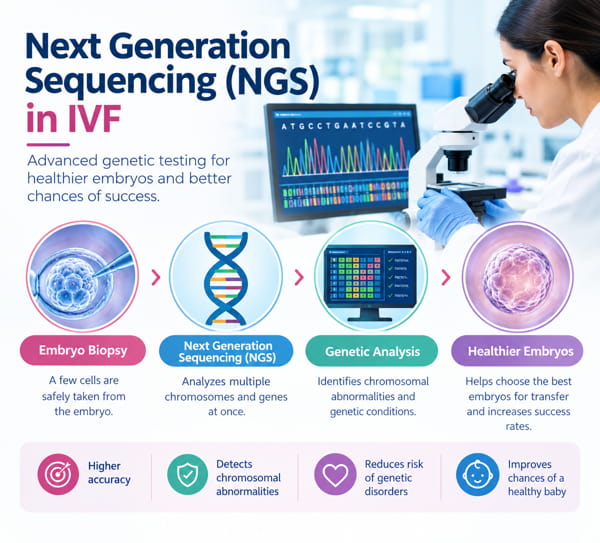
Simplified illustration of how a biopsy sample can be analysed for chromosome patterns. It is not an actual embryo image or a laboratory test result.
What Is Next Generation Sequencing (NGS)?
Next Generation Sequencing, commonly called NGS, is a method that allows laboratories to analyse large amounts of DNA. In IVF, it may be used as part of Preimplantation Genetic Testing for Aneuploidy (PGT-A), which assesses whether a sampled group of embryo cells shows evidence of missing or extra chromosomes.
Most human cells typically contain 46 chromosomes arranged in 23 pairs. This includes 22 pairs of autosomes and one pair of sex chromosomes. An embryo with a missing or extra chromosome may be described as aneuploid.
Embryos are usually assessed in the laboratory by their development and appearance. However, appearance alone cannot reliably reveal chromosome status. NGS-based PGT-A provides additional genetic information that may help a fertility team consider which embryos to transfer.
A result reported as euploid means the sampled cells show a chromosome pattern consistent with the expected number. It does not mean the embryo is guaranteed to implant or develop into a healthy baby, and it does not rule out every genetic condition.
NGS is a testing technology, not a separate IVF treatment. Its clinical role depends on the type of genetic test being performed and the patient's circumstances.
How Does NGS-Based PGT-A Work?
The process generally involves several steps:
- IVF and embryo development: Eggs are fertilised in the laboratory, and embryos are monitored as they develop. Biopsy for PGT-A is commonly performed at the blastocyst stage, often on Day 5, Day 6 or sometimes Day 7.
- Embryo biopsy: A trained embryologist removes a small number of cells from the trophectoderm, the outer layer that contributes mainly to the placenta. The biopsy does not directly sample the inner cell mass that develops into the fetus, but the procedure still carries a risk of embryo damage.
- DNA analysis: The genetic material from the sample is prepared and analysed using a laboratory method such as NGS.
- Laboratory report: The laboratory reports the chromosome findings. Depending on the test and laboratory, results may be classified as euploid, aneuploid, mosaic or inconclusive.
- Clinical discussion: The fertility specialist considers the report, embryo development, the patient's medical history and other relevant factors before discussing possible transfer options.
Embryos are often frozen while the laboratory testing is completed. The exact process and timing vary between clinics and laboratories.
Understanding NGS-Based PGT-A Results
The result is one part of the overall IVF picture. Ask your clinic to explain the specific report and the limitations of the laboratory's test.
| Result | What it generally means | What to know |
|---|---|---|
| Euploid | The sampled cells show a chromosome pattern consistent with the expected number. | This can support embryo selection but does not guarantee pregnancy or rule out every genetic condition. |
| Aneuploid | The sample shows evidence of one or more missing or extra chromosomes. | The implications depend on the finding and the test. Discuss the report with your fertility specialist. |
| Mosaic | The sample shows a pattern suggesting a mixture of cells with different chromosome results. | The biopsy samples only a small part of the embryo. Interpretation and transfer decisions require specialised counselling. |
| Inconclusive | The laboratory cannot provide a clear result from the sample. | Your clinic may discuss repeat testing, re-biopsy or other options based on the circumstances and associated risks. |
What Is a Mosaic Embryo?
A mosaic result means that the biopsy contains evidence of cells with different chromosome patterns. Because the test examines a small sample from the embryo's outer layer, the result may not represent every cell in the embryo.
Some embryos reported as mosaic have resulted in healthy births, but outcomes vary depending on the chromosome finding, the reported level and the testing method. Mosaic results should not be interpreted without specialist guidance.
If a mosaic embryo is being considered for transfer, ask for genetic counselling about the specific result, potential risks, available alternatives and any recommended prenatal testing if pregnancy occurs.
Why Did NGS Become Widely Used Instead of Older FISH Testing?
Fluorescence In Situ Hybridization (FISH) was one of the earlier methods used to assess selected chromosomes. Traditional FISH-based embryo testing could examine only a limited number of chromosomes, depending on the test design.
NGS-based PGT-A can assess chromosome copy-number patterns across all chromosomes included in the test. It is generally performed on a biopsy from a blastocyst rather than on a cleavage-stage embryo.
These technical advances allow broader chromosome assessment than traditional limited-panel FISH. However, a more comprehensive test does not automatically mean that every patient will have a higher chance of taking home a baby. Clinical benefit depends on the patient group, the testing method and how the results affect treatment.
Potential Advantages of NGS-Based PGT-A
- Broad chromosome assessment: It can assess copy-number patterns across all chromosomes included in the test.
- Additional information for embryo selection: Results may help clinicians prioritise embryos for transfer in selected situations.
- Potentially fewer transfers involving aneuploid embryos: This may be helpful for some patients, although it does not guarantee that implantation failure or miscarriage will be avoided.
- Detection of some chromosome imbalances: Depending on the laboratory method and its validated limits, NGS may identify certain chromosome gains, losses and other copy-number changes.
- More informed counselling: Results can provide another source of information when discussing embryo-transfer options.
The accuracy and scope of testing depend on the laboratory's platform, quality controls, reporting thresholds and the type of chromosome change being assessed. NGS-based PGT-A does not detect every genetic or developmental problem.
Who May Consider NGS-Based PGT-A?
PGT-A is not necessary for every person undergoing IVF. Your fertility specialist may discuss it in light of your age, reproductive history, embryo numbers, treatment goals and the evidence relevant to your situation.
Situations where testing may be discussed include:
- Advanced maternal age: The likelihood of chromosome abnormalities generally increases with the age of the egg provider.
- Previous pregnancy affected by a chromosome abnormality: The appropriate test depends on the specific chromosome finding and family history.
- Recurrent pregnancy loss or previous unsuccessful IVF treatment: Testing may be discussed, but it is important to establish whether it is likely to improve outcomes in the individual case.
- Several embryos available for selection: PGT-A may provide additional information for prioritising embryos, although it can also leave fewer embryos available for transfer.
- Individual clinical considerations: A fertility specialist may discuss testing when the potential advantages, limitations and costs are relevant to the patient's goals.
These situations do not mean PGT-A is automatically recommended. Professional guidance, including the American Society for Reproductive Medicine's 2024 committee opinion, emphasises that the value of PGT-A as a routine screening test for all IVF patients has not been established.
Does NGS Increase the Chance of Having a Baby?
This is one of the most important questions to discuss before testing. NGS-based PGT-A can help identify embryos with chromosome results that may be more suitable for transfer. In some circumstances, it may reduce the chance of transferring an embryo with an identified chromosome abnormality and may reduce miscarriage risk.
However, selecting an embryo with a euploid result does not guarantee implantation, ongoing pregnancy or live birth. Evidence does not establish that routine PGT-A consistently increases the cumulative live-birth rate for every IVF patient, particularly when all embryos from an egg retrieval are considered.
PGT-A can also have limitations, including mosaic or inconclusive results, the possibility of embryo damage during biopsy, cost and the possibility that an embryo with reproductive potential may not be selected for transfer because of its result.
Ask your fertility specialist to explain the expected benefit in your particular circumstances, rather than relying only on a general success-rate figure.
Limitations and Risks to Understand
- No guarantee of pregnancy: Chromosome screening cannot predict every factor that influences implantation or fetal development.
- Biopsy-related risk: Embryo biopsy is a specialised procedure and can damage an embryo, even when performed by experienced embryologists.
- Sampling limitations: The biopsy samples a small number of cells from the trophectoderm, which may not reflect the chromosome pattern of every cell in the embryo.
- Mosaic or inconclusive findings: Some results are difficult to interpret and may require additional counselling or discussion of options.
- Additional cost and time: Testing adds laboratory costs and may affect the timing of embryo transfer.
- Not a test for every genetic condition: PGT-A primarily assesses chromosome number or copy-number patterns. It is different from PGT-M, which is used for certain single-gene conditions, and PGT-SR, which is used for certain structural chromosome rearrangements.
Even after a PGT-A result, routine prenatal care and screening remain important. Your clinician can explain whether diagnostic testing during pregnancy should be considered.
NGS vs PGT-A: What Is the Difference?
The terms NGS and PGT-A are related but do not mean the same thing.
| Term | Meaning |
|---|---|
| NGS | A DNA sequencing technology used to analyse genetic material. |
| PGT-A | A type of preimplantation genetic testing that assesses embryos for chromosome number abnormalities. |
| PGT-M | Testing designed to identify specific inherited single-gene conditions when appropriate. |
| PGT-SR | Testing used in selected cases involving structural chromosome rearrangements. |
NGS is one method that may be used for PGT-A and other genetic analyses. The appropriate test depends on the clinical question, the family's genetic history and the laboratory's validated testing options.
Have Questions About Fertility Treatment?
Contact Select A Baby for information and patient coordination support.
Contact UsFrequently Asked Questions About NGS in IVF
Final Thoughts
Next Generation Sequencing is a laboratory technology that can provide useful chromosome information when used for PGT-A during IVF. It can support embryo selection in selected cases, but it cannot guarantee a successful pregnancy and is not necessary for every IVF cycle.
Before deciding on testing, discuss your age, reproductive history, number of embryos, the potential for mosaic or inconclusive results, the costs and the evidence relevant to your situation. If a genetic result is complex, a genetic counsellor may help you understand your options.
An individualised discussion with your fertility specialist can help you make an informed decision that fits your medical needs and personal goals.
References and Further Reading
The following professional resources provide additional information about preimplantation genetic testing and the interpretation of mosaic results.
-
Practice Committee of the American Society for Reproductive Medicine and Society
for Assisted Reproductive Technology. The use of preimplantation genetic
testing for aneuploidy: a committee opinion. Fertility and Sterility, 2024.
Read ASRM practice guidance -
American Society for Reproductive Medicine. Clinical management of mosaic
results from preimplantation genetic testing for aneuploidy of blastocysts:
a committee opinion. 2023.
Explore ASRM guidance on mosaic results -
American College of Obstetricians and Gynecologists (ACOG).
Preimplantation Genetic Testing.
Explore ACOG clinical guidance -
PubMed. Research literature on PGT-A, NGS, randomised trials and IVF outcomes.
Search peer-reviewed PGT-A research
References are provided for further reading. Please check the latest professional guidance and discuss how it applies to your individual situation with your clinician.
Medical Disclaimer
This article is for general educational purposes and is not a substitute for personalised medical advice, diagnosis or treatment. Select A Baby provides information and patient-coordination support; medical care and treatment decisions should be made with appropriately licensed fertility professionals. Testing availability, clinical recommendations and regulations may vary by country and clinic.
Have Questions About IVF Testing?
Learn more about fertility care and prepare questions to discuss with your fertility specialist.
Contact Select A Baby