Educational information about IVF and embryo cryopreservation
What Is Embryo Freezing?
Embryo freezing, also called embryo cryopreservation, is a process used during in vitro fertilisation (IVF) to preserve suitable embryos for possible use in a future treatment cycle. The embryos are cooled and stored under carefully controlled laboratory conditions.
Some patients have suitable embryos remaining after an IVF cycle. In other situations, a fertility specialist may recommend delaying embryo transfer for medical or treatment-planning reasons. Whether freezing is appropriate depends on the individual clinical situation.
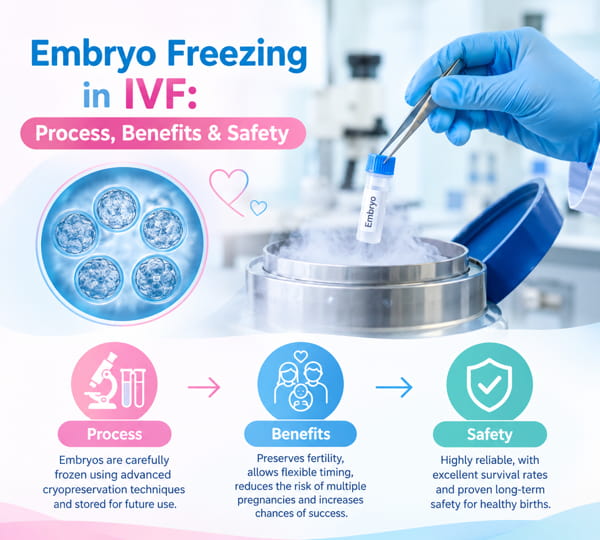
Illustration: the typical stages of embryo cryopreservation and later warming. Procedures are performed by trained embryology professionals.
Why Do Fertility Specialists Recommend Embryo Freezing?
Embryo freezing may be considered for different clinical reasons. Your fertility specialist will explain whether it is appropriate for your treatment plan.
1. To help reduce the risk of ovarian hyperstimulation syndrome (OHSS)
Some patients respond strongly to fertility medicines, which can lead to ovarian hyperstimulation syndrome (OHSS). In selected cases, freezing suitable embryos and delaying transfer may reduce the risk of OHSS becoming more severe. The decision depends on the patient's response and clinical assessment.
2. When hormone levels or the uterine lining affect timing
An early rise in progesterone or other clinical findings may influence the timing of embryo transfer. A later frozen embryo transfer may be recommended when the fertility specialist considers it more appropriate.
3. When preimplantation genetic testing (PGT) is planned
When preimplantation genetic testing is planned, embryos may be biopsied and frozen while the laboratory processes the samples. The testing method and results affect the subsequent treatment plan. Read our guide to PGT-A chromosome screening for additional background.
4. When embryos need more time for assessment
Embryos develop at different rates. An embryologist assesses their stage and quality to determine whether freezing is appropriate. The day an embryo reaches a developmental stage does not, by itself, determine its potential.
5. When transfer needs to be delayed for a medical reason
If a uterine or other medical issue needs further assessment, the fertility specialist may recommend postponing transfer while the issue is evaluated or treated.
6. When suitable embryos remain after an IVF cycle
Suitable additional embryos may be frozen for possible future use. This can provide another transfer opportunity without repeating ovarian stimulation and egg collection, although a separate transfer cycle and monitoring are generally needed.
How Does the Embryo Freezing Process Work?
Many IVF laboratories use a rapid-freezing method called vitrification. It uses carefully controlled cooling and protective solutions to reduce ice-crystal formation.
- Embryo assessment: The embryologist evaluates embryo development and suitability for freezing.
- Protective solution: Suitable embryos are exposed to cryoprotective solutions under controlled conditions.
- Rapid cooling: The embryo is cooled rapidly using a validated laboratory protocol.
- Storage: Frozen embryos are stored in specialised equipment, commonly in liquid nitrogen at approximately -196°C.
- Warming before use: When a transfer is planned, the laboratory warms the selected embryo and assesses it before transfer.
Many embryos survive warming when modern methods are used, but survival is not guaranteed. Outcomes depend on embryo characteristics, laboratory procedures, and individual circumstances. For more technical information, see the American Society for Reproductive Medicine's guidance on vitrification.
How Long Can Embryos Stay Frozen?
Embryos may be stored for extended periods under appropriate cryogenic conditions. Storage duration, however, is governed by applicable law, clinic policies, consent requirements, and the patient's circumstances.
Ask your clinic about the permitted storage period, renewal of consent, storage fees, contact requirements, and options if you decide not to use the embryos. Rules differ between countries, so do not rely on another country's storage limit as a rule for the UAE.
For general patient information, see the Human Fertilisation and Embryology Authority's guide to embryo freezing. Its legal information applies to the UK and should not be treated as UAE legal advice.
Success Rates with Frozen Embryos
Pregnancy and live-birth outcomes after frozen embryo transfer vary from person to person. Factors that may affect outcomes include:
- The woman's age when the eggs were collected.
- Embryo quality and developmental stage.
- Results of genetic testing, when performed.
- The laboratory's freezing and warming procedures.
- The uterine environment and preparation of the uterine lining.
- Medical history and other fertility-related factors.
Frozen embryo transfer is not automatically more successful than fresh transfer for every patient. Research comparing approaches reports different outcomes depending on the patient group and treatment strategy. Discuss personalised estimates with your fertility specialist.
For a research overview, read the Cochrane review: Fresh versus frozen embryo transfers for assisted reproduction.
Is Embryo Freezing Safe for the Baby?
Embryo freezing is an established part of IVF treatment, and available research provides useful information about outcomes after frozen embryo transfer. However, no fertility treatment can guarantee pregnancy or the birth of a healthy baby.
Some studies report differences in certain pregnancy or newborn outcomes between frozen and fresh transfers. These differences may relate to the transfer protocol, patient characteristics, and other clinical factors, and should be interpreted in context.
Your fertility specialist can discuss the potential benefits, limitations, and risks based on your medical history and treatment plan.
What Happens During a Frozen Embryo Transfer?
A frozen embryo transfer (FET) involves preparing the uterine lining, warming a selected embryo, and placing it into the uterus. The exact approach depends on your menstrual cycle and clinical circumstances.
- Cycle planning: The specialist decides whether a natural, modified-natural, or hormone-prepared cycle is suitable.
- Uterine lining assessment: Ultrasound scans and sometimes hormone tests help assess readiness.
- Embryo warming: The laboratory warms the selected embryo and checks its condition.
- Embryo transfer: The embryo is placed into the uterus using a thin catheter.
- Pregnancy testing: The clinic advises when to test and arranges follow-up care.
A frozen embryo transfer generally does not require another egg collection, but medicines, monitoring, and preparation may still be necessary. For more information about treatment coordination, see our guide to the IVF process for international patients in Dubai.
Need information about IVF in Dubai?
Send an enquiry to our coordinators for information about planning a visit and connecting with fertility care providers.
Send an enquiryFrequently Asked Questions About Embryo Freezing
Is embryo freezing painful?
The freezing procedure takes place in the laboratory and is not performed directly on the patient. Egg collection is a separate procedure. A later embryo transfer is usually performed without general anaesthesia, although some patients may experience mild discomfort.
Do frozen embryos have lower success rates than fresh embryos?
Not necessarily. Outcomes vary according to patient characteristics, embryo factors, and treatment protocols. Neither fresh nor frozen transfer is best for every patient.
Can all embryos be frozen?
No. The embryologist assesses embryo development and quality to determine which embryos are suitable for storage.
How many times can I try with frozen embryos?
The number of possible attempts depends on the number of suitable embryos in storage, their survival after warming, medical considerations, and applicable clinic and legal requirements.
What happens if I do not use my frozen embryos?
Available options depend on applicable law, clinic policies, and the consent provided. Discuss continued storage, donation where permitted, or disposal with your clinic.
Does age matter when using frozen embryos?
Age when the eggs were collected is an important factor in embryo potential. Age and health at the time of pregnancy can also affect pregnancy-related risks.
Final Thoughts
Embryo freezing can provide additional opportunities for future transfers, help manage some treatment risks, and allow transfer timing to be planned around medical needs. It is not appropriate for every patient, and individual outcomes vary.
Ask your fertility specialist about the likely benefits, risks, storage terms, costs, and alternatives for your circumstances.
References and Further Reading
The following resources provide further information. Some guidance is jurisdiction-specific; UK legal information, for example, does not define the rules that apply in the UAE.
- Human Fertilisation and Embryology Authority (HFEA). Embryo freezing: patient information.
- American Society for Reproductive Medicine (ASRM). A review of best practices of rapid-cooling vitrification for oocytes and embryos: a committee opinion. Fertility and Sterility. 2021.
- Zaat T, Zagers M, Mol F, et al. Fresh versus frozen embryo transfers for assisted reproduction. Cochrane Database of Systematic Reviews. 2021; CD011184. https://doi.org/10.1002/14651858.CD011184.pub3.
- National Library of Medicine, PubMed Central. Full-text article: Fresh versus frozen embryo transfers in assisted reproduction.
References were selected for general educational context. Please verify the linked publications and review this medical content with a qualified fertility professional before publication.