IVF and Fertility Education
Educational information only. No lifestyle change, supplement or test can guarantee improved egg quality or pregnancy.
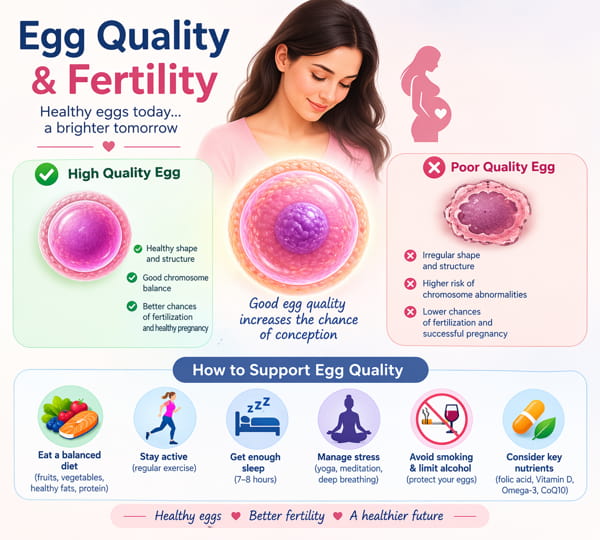
Illustrative graphic only. Egg quality cannot be determined from an image or from ovarian reserve tests alone.
Why Egg Quality Matters
Egg quality refers broadly to an egg's ability to mature, be fertilised and support normal embryo development. Chromosome status is an important part of this picture, but egg quality is not a single measurement that can be directly tested in every situation.
During IVF, eggs are collected and assessed for maturity. After fertilisation, embryologists monitor embryo development. Some embryos stop developing or have chromosome abnormalities, and these outcomes can be influenced by several factors, including the age of the egg provider.
As women age, both the number of eggs remaining and the proportion of eggs capable of supporting a chromosomally typical embryo generally decline. This age-related change becomes more important during the later reproductive years, although the pace differs between individuals.
Chromosome abnormalities are a common cause of early pregnancy loss. However, not every miscarriage is caused by an egg-related chromosome problem, and egg quality is only one of several factors that influence fertility outcomes.
Can Egg Quality Be Improved?
There is currently no proven treatment that reliably reverses age-related changes in egg quality. Age remains one of the strongest factors associated with egg chromosome status and reproductive outcomes.
Healthy habits can support general health and may help address factors that affect reproductive wellbeing. However, they cannot guarantee that eggs will become chromosomally normal or that IVF will be successful.
You may hear that eggs take approximately three months to mature. Follicle development is a complex process that occurs over time, so starting healthy habits a few months before trying to conceive or starting IVF can be a practical goal. There is no exact three-month window that guarantees an improvement in egg quality.
If age or a known medical condition makes time important, speak with a fertility specialist early rather than delaying assessment to try lifestyle changes alone.
Practical Steps to Support Reproductive Health
1. Adopt a Fertility-Friendly Lifestyle
Everyday habits can support your general health before pregnancy and fertility treatment. Consider the following steps:
- Avoid smoking: Smoking is associated with poorer reproductive health and earlier loss of ovarian function. Seek help if you need support to quit.
- Review alcohol use: Avoid heavy drinking and discuss alcohol with your clinician when planning pregnancy. Avoid alcohol during pregnancy.
- Keep caffeine moderate: Discuss your usual caffeine intake with your clinician. Pregnancy guidance commonly recommends limiting caffeine to no more than 200 mg per day.
- Eat a varied diet: Include vegetables, fruit, whole grains, legumes, suitable protein sources and unsaturated fats.
- Maintain a healthy weight where possible: Both very low and high body weight may affect ovulation and general health.
- Exercise regularly: Choose sustainable activities such as walking, swimming or yoga, adjusted to your fitness and medical needs.
These measures support overall wellbeing. Evidence does not show that any specific diet or exercise routine can reliably reverse age-related egg-quality decline.
2. Eat a Balanced, Nutrient-Rich Diet
A balanced diet provides nutrients needed for normal body function and helps support health before pregnancy. A Mediterranean-style eating pattern is one reasonable approach, emphasising vegetables, fruits, whole grains, beans, nuts, seeds, fish and unsaturated fats.
Practical ways to improve your diet include:
- Include a variety of colourful vegetables and fruits.
- Choose whole grains and fibre-rich foods regularly.
- Include appropriate sources of protein, such as beans, lentils, eggs, fish or poultry.
- Choose healthy fats from nuts, seeds, fish and vegetable oils.
- Reduce reliance on highly processed foods and excess added sugar.
If you are planning pregnancy, ask your clinician about folic acid. In many guidelines, people planning pregnancy are advised to take 400 micrograms of folic acid daily, starting before conception. Some medical circumstances require a different dose under professional guidance.
A healthy diet supports general health, but no particular food can guarantee better egg quality or IVF success.
3. Manage Stress and Protect Your Wellbeing
Fertility concerns and treatment can be emotionally demanding. Stress management may help with sleep, mood and coping during the fertility journey. However, there is no strong evidence that eliminating stress directly improves egg quality.
You may find it helpful to practise breathing exercises, mindfulness, gentle yoga, walking or other relaxing activities. Talking with a counsellor, partner, trusted friend or support group can also help.
You do not need to blame yourself for feeling stressed. Fertility outcomes are influenced by many biological and medical factors, and stress alone does not explain infertility.
4. Consider Complementary Therapies Carefully
Some people consider acupuncture, massage or other complementary approaches during fertility treatment. These may help some individuals feel more relaxed, but evidence that they improve egg quality or increase live-birth rates is limited or inconsistent.
Discuss complementary therapies with your fertility specialist, particularly if you are taking medication, undergoing ovarian stimulation or preparing for an egg collection. Choose qualified practitioners and avoid products that promise guaranteed fertility improvement.
5. Discuss Supplements With Your Fertility Specialist
Coenzyme Q10 (CoQ10) and other supplements are being studied for possible effects on reproductive outcomes. Some early findings are of interest, but current evidence is not strong enough to say that these supplements reliably improve egg quality or increase live-birth rates for everyone.
Supplements may cause side effects, interact with medicines or be unsuitable for certain health conditions. Tell your clinician about everything you take, including herbal products and over-the-counter vitamins.
Do not replace prescribed treatment or delay fertility assessment in the hope that supplements will reverse age-related changes.
How Can You Check Your Ovarian Reserve?
Ovarian reserve refers to the remaining pool of eggs or follicles in the ovaries. Ovarian reserve tests can help estimate how the ovaries may respond to fertility medication, but they do not directly measure the quality of individual eggs.
Anti-Müllerian Hormone (AMH)
AMH is a hormone produced by cells in small developing ovarian follicles. A blood test can help estimate ovarian reserve and may help predict how the ovaries respond to stimulation during IVF.
AMH does not directly measure egg quality and should not be used alone to determine whether natural conception is possible. Results must be interpreted in context, including age and medical history.
Antral Follicle Count (AFC)
Antral follicle count is measured using an ultrasound, usually early in the menstrual cycle. The clinician counts small follicles visible in the ovaries. This provides an estimate of ovarian reserve and can help with IVF treatment planning.
AFC does not reveal the chromosome status of individual eggs. Results may also depend on the ultrasound technique, the clinician and other clinical factors.
Follicle-Stimulating Hormone (FSH)
FSH is a hormone measured through a blood test, often early in the menstrual cycle when used for ovarian reserve assessment. Higher levels can sometimes indicate reduced ovarian reserve, but FSH varies and is usually interpreted alongside other results.
| Test | What it helps assess | Important limitation |
|---|---|---|
| AMH | Estimate of ovarian reserve and likely response to stimulation. | Does not directly measure egg quality or guarantee natural conception. |
| AFC | Ultrasound estimate of the small follicles visible in the ovaries. | Does not reveal the chromosome status of individual eggs. |
| FSH | Hormonal information that may support ovarian reserve assessment. | Can vary between cycles and is interpreted alongside other information. |
A fertility specialist may also consider your menstrual history, age, previous pregnancies, medical conditions and other tests. No single ovarian reserve test provides a complete picture of fertility.
How Does Age Affect Egg Quality?
The number of eggs remaining in the ovaries generally decreases over time. In addition, the proportion of eggs with chromosome abnormalities tends to increase with age. This can affect fertilisation, embryo development, miscarriage risk and the likelihood of a live birth.
Fertility changes do not happen at the same rate for everyone. Age is an important factor, but it cannot predict an individual's outcome with certainty. A younger person can have reduced ovarian reserve, while someone older may still conceive.
If you are considering pregnancy, IVF or egg freezing, an early consultation can help you understand the options available to you. Egg freezing may preserve eggs at the age they are collected, but it does not guarantee a future pregnancy or live birth.
Important Reality Check: What Tests Can and Cannot Tell You
It is understandable to want a simple test that tells you whether your eggs are healthy. At present, there is no routine blood test or ultrasound that can directly measure the quality of every egg in the ovaries.
- AMH and AFC: Primarily help estimate ovarian reserve and likely response to stimulation.
- Age: Provides important information about the probability of chromosome abnormalities, but does not determine an individual outcome.
- Embryo assessment: Embryo development and appearance provide useful information, but cannot identify every genetic or developmental issue.
- PGT-A: Can assess chromosome copy-number patterns in a biopsy from an embryo, but does not directly test every egg or guarantee a successful pregnancy.
The most useful approach is to combine your medical history, age, test results and reproductive goals in a discussion with a qualified fertility specialist.
Have Questions About Fertility Treatment?
Contact Select A Baby for information and patient coordination support.
Contact UsFrequently Asked Questions About Egg Quality
Final Thoughts
Egg quality is an important aspect of fertility, and age is a major factor in age-related changes. Although no lifestyle change or supplement can reliably reverse these changes, healthy habits can support your overall wellbeing and preparation for pregnancy.
Understanding ovarian reserve tests can help you plan, but AMH, FSH and antral follicle count do not directly measure egg quality. Your age, health, reproductive history and personal goals all matter when considering fertility treatment.
If you are planning a pregnancy, considering IVF or exploring egg freezing, speak with a fertility specialist early. An individualised assessment can help you understand your options and make informed decisions.
References and Further Reading
-
American Society for Reproductive Medicine (ASRM). Practice guidance on ovarian
reserve testing and fertility treatment.
Explore ASRM practice guidance -
American College of Obstetricians and Gynecologists (ACOG). Patient and clinical
resources on female fertility and reproductive health.
Explore ACOG women's health resources -
Centers for Disease Control and Prevention (CDC). Information about folic acid
before and during early pregnancy.
Read CDC folic acid guidance -
PubMed. Peer-reviewed research on ovarian reserve, AMH, age-related egg quality
and fertility outcomes.
Search research on ovarian reserve and egg quality
These resources are provided for further reading. Clinical recommendations may change as new evidence becomes available. Discuss individual results and treatment decisions with a qualified healthcare professional.
Medical Disclaimer
This article is for general educational purposes and is not a substitute for personalised medical advice, diagnosis or treatment. Select A Baby provides information and patient-coordination support; medical evaluation and treatment should be provided by appropriately licensed healthcare professionals. Do not start supplements or delay fertility assessment based on this article alone.
Planning Pregnancy or Considering IVF?
Learn more about fertility care and prepare questions to discuss with your fertility specialist.
Contact Select A Baby