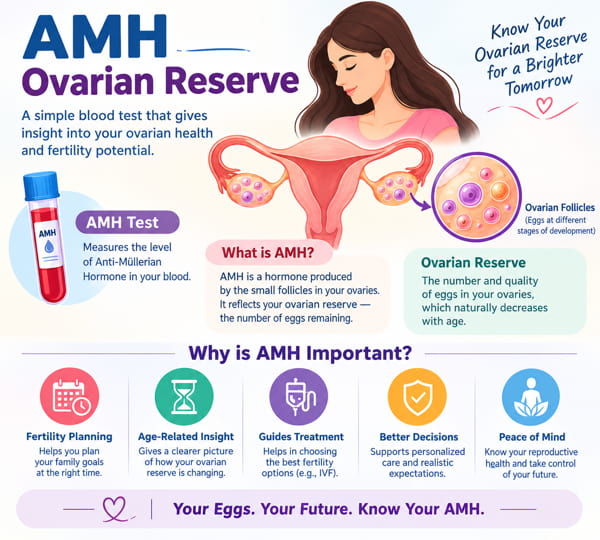
AMH testing helps estimate ovarian reserve; it does not directly measure egg quality or guarantee a pregnancy outcome.
What Is an AMH Test?
An AMH (Anti-Müllerian Hormone) test is a blood test that measures the amount of AMH in your bloodstream. In women, AMH is commonly used as one marker of ovarian reserve—an estimate of the remaining supply of eggs in the ovaries.
The test can help a fertility specialist understand how the ovaries may respond to fertility medications, particularly during IVF or egg freezing. However, it cannot tell you exactly how many eggs remain or determine by itself whether you will become pregnant.
What Is Anti-Müllerian Hormone?
AMH is a hormone produced by granulosa cells in small developing follicles in the ovaries. These follicles contain immature eggs. In general, AMH levels are associated with the number of small follicles present.
- Higher AMH: may indicate a larger pool of small developing follicles.
- Lower AMH: may indicate a smaller pool of small developing follicles.
AMH levels generally decline with age as ovarian reserve decreases. The pattern differs from person to person, so a result should be interpreted alongside age, medical history and other findings.
What Can an AMH Test Tell You?
An AMH test can help your fertility specialist:
- Assess ovarian reserve as part of a broader fertility evaluation.
- Estimate the likely response to ovarian stimulation medication during IVF or egg freezing.
- Plan medication doses and discuss the possibility of a lower or higher response to treatment.
- Interpret other findings, such as an antral follicle count from an ultrasound.
AMH is particularly useful for estimating the number of eggs that might be retrieved during an IVF stimulation cycle. The actual response can still differ from the estimate.
What Can an AMH Test Not Tell You?
AMH is useful, but it is not a complete fertility test. It has important limitations:
- It does not measure egg quality. AMH mainly provides information about ovarian reserve, while age is an important factor associated with egg quality.
- It cannot reliably predict natural conception. A single AMH result does not tell you whether or when you will conceive naturally.
- It cannot give an exact menopause date. AMH alone cannot accurately determine when menopause will occur.
- It does not assess every fertility factor. Sperm health, ovulation, fallopian tube health, the uterus and other medical factors also matter.
A low AMH result does not mean pregnancy is impossible. Likewise, a higher result does not guarantee fertility or a successful pregnancy.
Understanding AMH Levels
AMH is often reported in nanograms per millilitre (ng/mL), although some laboratories use other units. There is no single universal reference range that applies to every age group, laboratory or testing method.
You may see broad categories used in some fertility settings, such as the examples below. These are illustrative only, not diagnostic cutoffs or a substitute for the reference range on your own laboratory report.
| Example AMH result | Possible general interpretation |
|---|---|
| Below 1.0 ng/mL | May be associated with lower ovarian reserve, depending on age and the laboratory method. |
| About 1.0–3.0 ng/mL | May fall within a range seen in some patients, but interpretation depends on age and clinical context. |
| Above 3.0 ng/mL | May reflect a larger pool of small follicles. Higher levels can occur in people with PCOS, but AMH alone cannot diagnose it. |
These broad categories should not be used to label an individual result as normal or abnormal without clinical interpretation. Different laboratories may use different assays and reference ranges, and the same value can have different implications at different ages.
If your result is reported in pmol/L rather than ng/mL, do not compare the numbers directly. Ask your clinician or laboratory to explain the units and reference range.
What Can Cause a High or Low AMH Result?
Low AMH
Lower AMH may be associated with a smaller pool of developing follicles. Age is one important factor, but ovarian surgery, certain medical treatments and individual differences can also be relevant. A low result does not, on its own, establish infertility.
High AMH
Higher AMH can reflect a larger number of small follicles. It is sometimes seen in people with polycystic ovary syndrome (PCOS), but AMH should not be used alone to diagnose PCOS. A clinician considers symptoms, menstrual history, examination and other tests as appropriate.
When Should You Consider an AMH Test?
A healthcare professional may recommend AMH testing as part of a fertility assessment or treatment-planning discussion, for example if you:
- Are having difficulty conceiving and are undergoing a fertility evaluation.
- Are considering IVF or egg freezing.
- Have a medical history that may affect ovarian function.
- Need information to help plan fertility treatment.
AMH can generally be measured at any point in the menstrual cycle. However, some circumstances and medications can affect interpretation, so follow the instructions from your clinician and laboratory.
AMH testing is not a guarantee of future fertility. Whether it is useful for you depends on your age, medical history, reproductive goals and the reason for testing.
Is AMH More Important Than Age?
No. Age remains a key factor in reproductive potential, particularly because egg quality and the likelihood of chromosomal abnormalities change with age. AMH provides additional information about ovarian reserve and the expected response to fertility medication.
For example, two people of the same age may have different AMH results and respond differently to ovarian stimulation. Their chances of pregnancy, however, cannot be determined from AMH alone.
Can You Increase Your AMH Level?
AMH largely reflects the pool of small developing follicles. There is currently no established treatment proven to reliably increase AMH over the long term or replenish the remaining egg supply.
Healthy habits can support general health and wellbeing, but they should not be presented as a proven way to restore ovarian reserve. Be cautious about supplements or treatments advertised as guaranteed ways to raise AMH, and discuss them with a qualified healthcare professional before use.
Have Questions About Fertility Treatment?
Contact Select A Baby for information and patient coordination support.
Contact UsFrequently Asked Questions About AMH
Final Thoughts
An AMH test can provide useful information about ovarian reserve and help fertility specialists plan treatment. It may be particularly helpful when estimating the likely response to ovarian stimulation during IVF or egg freezing.
However, AMH is only one part of the fertility picture. Your age, medical history, ovulation, sperm health and other reproductive factors also matter. A result should be interpreted in context rather than used on its own to predict pregnancy.
If you have questions about your AMH result or fertility options, speak with a qualified fertility specialist who can explain the findings and discuss appropriate next steps.