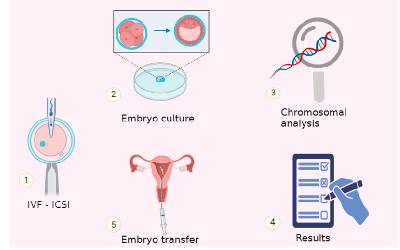
IVF and PGT-A Process: From Egg Retrieval to Embryo Transfer
A step-by-step educational guide to IVF treatment, embryo development, chromosome testing and embryo transfer.
Many couples exploring advanced fertility options want to understand the practical steps involved when IVF is combined with embryo testing that provides information about sex chromosomes. This process is sometimes discussed in the context of family balancing.
Below is a clear overview of how the medical and laboratory steps work, from the start of IVF treatment through embryo development, genetic analysis and transfer. The information is educational and does not guarantee any particular outcome.
1. IVF Treatment Process
The foundation of the process is a standard IVF treatment pathway. The main stages generally include:
-
Ovarian stimulation
Fertility medications are used for approximately 8–14 days in many treatment protocols to encourage the ovaries to develop multiple follicles. The duration and medication plan vary between patients. -
Monitoring
Ultrasound scans and blood tests help the clinical team monitor follicle development and hormone levels so that treatment timing can be adjusted. -
Egg retrieval
When the follicles are considered ready, eggs are collected through a short procedure, usually performed with sedation. -
Sperm preparation and fertilisation
On the same day, sperm is prepared and used to fertilise the eggs. Depending on the clinical circumstances, fertilisation may involve conventional IVF or ICSI (intracytoplasmic sperm injection), in which a single sperm is injected into a mature egg.
This creates embryos that will be monitored in the laboratory. For more information about beginning the process, visit our IVF Consultation and Clinic Matching page .
2. Embryo Development
After fertilisation, embryos are placed in carefully controlled laboratory conditions and monitored as they develop.
- Day 1–3: Early cell divisions occur as the fertilised egg develops.
- Day 5–6: Some embryos reach the blastocyst stage. A blastocyst contains an inner cell mass, which can develop into the fetus, and an outer layer of cells called the trophectoderm, which contributes to the placenta.
Embryos that reach a suitable blastocyst stage may be considered for biopsy and genetic testing. Not every embryo reaches this stage. Development rates vary depending on factors such as age, egg and sperm quality, and laboratory conditions.
3. PGT Testing and Chromosome Analysis
Once a suitable blastocyst has formed, a small number of cells may be removed from the trophectoderm through a procedure called embryo biopsy. The sampled cells can then be sent for Preimplantation Genetic Testing for Aneuploidy (PGT-A).
PGT-A examines chromosome number and can provide information about:
- Whether the tested sample shows the expected chromosome number (often described as euploid) or an atypical chromosome number (aneuploid).
- The sex chromosome pattern, such as XX or XY, when this information is included in the report.
Modern testing methods may use next-generation sequencing (NGS) to analyse DNA from the biopsied cells. Results can help the clinical team assess embryos, but they do not provide a complete picture of every cell in an embryo.
Some results may be reported as mosaic, meaning the tested sample suggests a mixture of cell lines with different chromosome findings. Mosaic results require careful interpretation and genetic counselling.
Learn more about this topic on our PGT-A Embryo Screening page .
It is important to understand that PGT-A is a screening test. It does not diagnose every possible genetic condition, and results are not infallible. The findings are used to support clinical discussions about the embryos that have developed.
4. Embryo Transfer Process
After genetic testing results become available, the fertility team reviews the findings and discusses possible next steps with the patient.
- Embryos considered suitable for transfer may be discussed with the clinical team.
- In many PGT-A cycles, embryos are frozen after biopsy while the laboratory completes testing. Transfer may then take place in a later frozen embryo transfer cycle.
- A single embryo transfer is commonly considered to reduce the risks associated with multiple pregnancy. The number transferred is determined by the treating specialist.
- Other suitable embryos may be cryopreserved for possible future use, depending on clinical advice and patient consent.
Embryo transfer is generally performed without general anaesthesia. A pregnancy test is commonly arranged around 10–14 days after transfer, depending on the clinic's protocol.
For couples interested in the broader context of this technology, visit our Family Balancing IVF page.
5. Important Limitations of IVF and PGT-A
Although IVF and PGT-A can provide useful information, there are important limitations to understand before considering treatment.
- Not every IVF cycle produces embryos suitable for biopsy.
- Not every biopsied embryo produces a clear or conclusive result.
- The availability of embryos with a particular sex chromosome pattern is never guaranteed.
- A chromosomally suitable result does not guarantee implantation, ongoing pregnancy or live birth.
- Age, embryo quality, uterine factors and overall health can influence outcomes.
- PGT-A is not recommended as a routine test for every IVF patient; its use should be individualised.
Patients should discuss the possible benefits, limitations, costs and alternatives with a qualified fertility specialist before making a decision.
6. Frequently Asked Questions
7. Final Thoughts
IVF combined with PGT-A involves several medical and laboratory stages: ovarian stimulation, fertilisation, embryo culture to the blastocyst stage, biopsy, chromosome analysis and planned embryo transfer.
Each stage has its own variables and limitations. A detailed consultation with a fertility specialist is the best way to understand whether this pathway is appropriate, what realistic expectations look like and how the process may apply to individual circumstances.
To explore the topic further, visit our Family Balancing IVF page or learn about our IVF consultation and clinic matching support .
Author / Medical Review
This content has been prepared by Select A Baby for educational purposes and reviewed for general consistency with reproductive medicine practice. It is not a substitute for individual medical review by a qualified fertility specialist.
Medical Disclaimer
This article is for informational purposes only and does not constitute medical advice, diagnosis or treatment. Individual results vary widely. No process described here guarantees pregnancy, live birth or any specific outcome regarding the sex of a child. Decisions about fertility treatment should be made only after personalised consultation with a qualified fertility specialist. Always seek professional medical advice tailored to your situation.
Select A Baby provides information and coordination support. Medical assessment, fertility treatment, laboratory testing and embryo transfer are provided by appropriately licensed healthcare professionals and clinics.
References and Further Reading
The following professional organisations and publications provide further information about IVF, PGT-A and embryo testing:
-
American Society for Reproductive Medicine (ASRM)
Practice Committee of the ASRM. The use of preimplantation genetic testing for aneuploidy: a committee opinion. Fertility and Sterility, 2024.
Read ASRM guidance and publications -
ReproductiveFacts.org
Patient education resources on IVF, fertility treatment and reproductive testing.
Visit ReproductiveFacts.org -
European Society of Human Reproduction and Embryology (ESHRE)
Professional guidance and educational resources on reproductive medicine, embryo testing and fertility care.
Visit ESHRE -
Fertility and Sterility Journal
Peer-reviewed research and clinical publications in reproductive medicine.
Explore Fertility and Sterility
Reference note: The links above lead to professional organisations and publication resources. Readers should consult the relevant publication directly for the full clinical guidance.
Explore Your IVF Options
Learn more about IVF pathways, embryo screening and fertility clinic options. A qualified fertility specialist can help you understand the medical considerations relevant to your circumstances.
Contact Select A Baby